Flat Pack, Folding, Expandable and Modular Container Houses Compared
Updated 2026-11-01 · JIUJIAN GLOBAL technical team
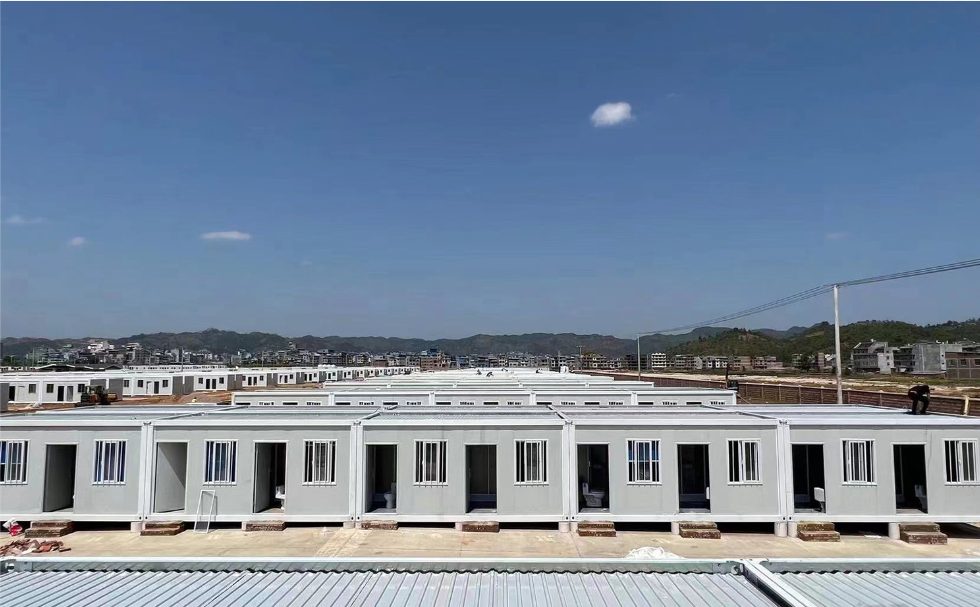
Flat pack ships as panels and frames at the highest density and needs 3-5 days of site assembly for a small camp; folding units arrive with walls and roof hinged and unfold in under an hour per unit; expandable units ship at half footprint and slide open to double the floor area with interior already fitted; modular units ship finished and are craned into place with almost no site work. Choose by labour cost and schedule on site, not by unit price alone.
All four families use the same corner casting and steel frame logic as an ISO container. What separates them is how much of the building is completed in the factory and how much has to happen after the truck leaves. That ratio determines shipping density, crane requirement, site labour and how quickly a camp becomes habitable.
The four families in one table
| Item | Flat pack | Folding | Expandable | Modular |
|---|---|---|---|---|
| Shipping form | Panels + frame, flat | Folded module | Closed module, half footprint | Finished module |
| Units per 40HQ | 4-6 kits | 2-3 units | 1-2 units | 1 unit |
| Site assembly | 2-5 days per unit with a crew | 2-6 hours per unit | 4-8 hours per unit | 1-2 hours, positioning only |
| Interior fitted in factory | No, or partial | Partial | Yes, fully fitted | Yes, fully fitted |
| Floor area | Fixed | Fixed | 2x when open | Fixed or stacked |
| Best for | Large camps, low labour cost sites | Fast deployment, repeated moves | Premium offices, hospitality | Urban or tight sites, multi-storey |
Flat pack: density wins
A flat pack kit fits four to six units into one 40HQ. That is the cheapest freight per square metre in the industry and the reason flat pack dominates large mining and construction camps where a crew is already on site and a crane is not always needed. The trade-off is assembly: wall panels, roof, floor covering, wiring terminations and plumbing connections all happen on site, so quality depends on who is doing it. Send a supervisor or insist on an assembly drawing set with numbered panels.
Folding: speed of redeployment
A folding unit keeps the walls and roof attached on hinges, so it opens into a finished shell in under an hour. The cost is structural compromise at the hinge line and a heavier closed module than flat pack. Folding units are the right answer when a unit will move three or four times over its life, for example construction site offices that follow a road or pipeline project.
Expandable: floor area from a small footprint
An expandable unit ships closed at roughly half its open width and slides or folds out to double the floor area, with bathroom, kitchen and partitions already fitted. It is the only family that delivers a finished interior at high shipping density. Expect a heavier module and a crane on site: a 40ft expandable open unit can exceed 7 t, so the lifting plan needs a proper spreader beam.
Modular: building, not kit
A modular unit leaves the factory complete. On site it is positioned, anchored, connected and commissioned. This is the most expensive form per square metre and the fastest to occupy, which is why it fits urban projects, sales suites, clinics and multi-storey buildings where a crane is already on site.
How to decide in practice
- Count the assembly hours you can actually buy at the destination. If labour is scarce, folding or modular beats flat pack even at a higher unit price.
- Check the road from port to site. If there are low bridges or narrow village roads, a folded module may not pass and a flat pack kit will.
- Ask whether the unit will be relocated. Repeated moves favour folding; a single installation for ten years favours flat pack or modular.
- For camps above 50 units, ask for a master plan with shared wet cores and walkways before choosing the family. Mixing types is often the cheapest answer.
Next step
Each family page carries its own specification table: flat pack container houses, Z-type folding container houses, expandable container houses and modular container buildings. If your project needs a non-standard size or a mixed camp, send the layout to custom container house and we will return a drawing set with the right family marked per building.
Need this priced for your project?
Send the unit type, quantity, destination port and any layout drawing. We reply with a specification-matched quotation and lead time, usually within one working day.
Request a quotation WhatsApp our team
Related: all container house products · custom container house · contact
Next step: get a real quotation
Tell us the destination port and the quantity, and we send a priced offer with drawings and a loading plan. Most enquiries are answered within one working day.